
How to Stop Procrastinating: 10 Practical Strategies That Actually Help
We arrived at a harsh and unpleasant truth in my previous article on the psychology of procrastination, namely that procrastination is an issue concerning emotional regulation and not a matter of time management.
If you haven’t already read that article, then I really do suggest that you start with it. You can’t overcome an enemy unless you first understand it. We have looked at the fact that our primitive brains are frightened by the negative emotions connected with hard work—such as anxiety, boredom and the fear of failure—and as a result we resort to an endless number of distractions in order to temporarily relieve that discomfort.
We always referred to a spade as a spade. You’re not lazy; your brain is simply opting for the immediate dopamine hit of a YouTube video rather than the reward that comes later from your long-term goals.
Insight without taking action is nothing but trivial stuff.
Since you understand the reason why your brain undermines you, it’s now time to rewire it. You don’t need a new expensive daily planner, a colour-coded calendar, or a motivational speech. What you need are tactics that work with your biology rather than against it.
Below is a neuroscience-supported and highly practical action plan on How to Stop Procrastinating finally and begin taking action.
Rule Zero: Stop Waiting for Motivation
Let’s be honest. Motivation won’t save you.
If procrastination is essentially about avoiding a negative feeling, then delaying until you ‘feel like it’ is just about waiting for the discomfort you’re trying to avoid to disappear magically. It rarely does.
The discomfort is an integral part of the task; those people who are actually responsible for getting things done haven’t worked out how to get rid of that sensation; instead, they have simply learned to begin while it is still there.
That is the reason why all the methods mentioned below apply at the start, not at the mood. It is not necessary for you to be ready; you only need to start.
1. The rule concerning the next physical action
As we mentioned in our previous post, huge and vague aims have a paralysing effect on the brain. Suppose you sit down at your desk and your to-do list includes something like “Write a blog post” or “Start a business”; in that case, your brain sees a huge and indistinct mountain and at once feels overwhelmed, prompting a desire to escape.
The only way to overcome ambiguity is by being extremely, almost ridiculously specific.
Rather than concentrating on the result, direct your attention to the following physical action. What exactly is the immediate, physical movement that your body needs to carry out in order to begin this task?
Rather say: “Work on my website.”
The next thing to do is to click on the Google Chrome icon, open WordPress and enter the title.
When you commit yourself to spending just two minutes on a task, you effectively bypass your brain’s threat-detection system (the amygdala). Such a short time period is so low-risk that your brain doesn’t go into panic mode. As soon as you begin working, the psychological resistance vanishes and momentum then takes over.
2. Draw up an “If-Then” plan (implementation intentions)
This technique is scientifically known as an implementation intention, which is just a fancy, academic name for an if-then plan:
If the situation exists, I will carry out the specific action.
For instance, if it’s 9:00 AM and I have finished drinking my coffee, I’ll open the report and write the first heading.
Peter Gollwitzer and Paschal Sheeran’s major review from 2006 looked at 94 separate studies and concluded that if-then plans had a medium to large effect on achieving one’s goals. Most significant of all was the fact that they were especially helpful in getting goal-directed action going, since starting is precisely the point at which procrastinators tend to get stuck.
As a matter of honesty, it should be pointed out that much of that research was not focused on procrastination and that you still need to care about the goal. While a plan cannot take the place of caring, it can turn caring into action.
3. Environment Design and Friction
The phone is designed by thousands of the world’s most intelligent engineers in order to grab your attention; while your long-term goal may bring you a reward in six months, the phone gives you a reward within three seconds.
It is no advantage to rely on sheer willpower in order to win that unfair competition; if you want to overcome distractions, then you must use Friction to shape your environment.
In terms of human behaviour, friction refers to the number of steps needed to carry out a particular action. If you want to stop putting off things, you should make it difficult to carry out bad habits and easy to carry out good ones.
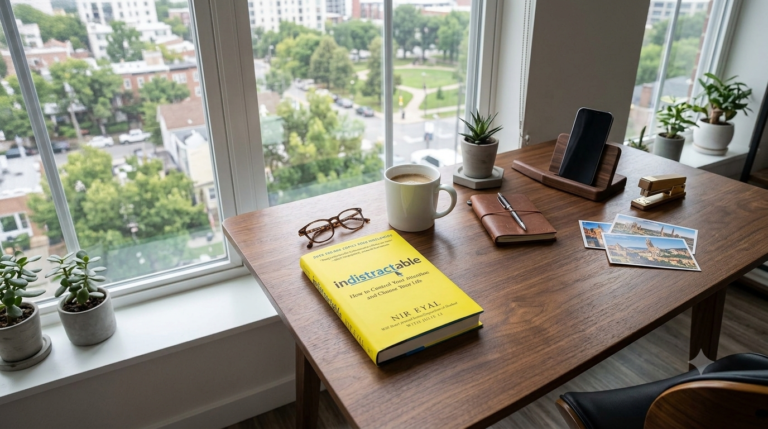
The most important point I picked up from my study of Nir Eyal’s Indistractable book summary on this site was the need to get rid of external triggers.
While you are working, place your phone in another room since the effort of getting up and walking down the hall is generally sufficient to overcome the urge.
Block websites to stop yourself from opening YouTube during work hours.
Remember:
You don’t have to defeat temptation every five minutes if you can remove the temptation in the first place.
4. Identify the emotion (interpreting the internal trigger)

Dr. Fuschia Sirois, who is a psychologist at Durham University, says that it is not the task itself that we are avoiding but the negative emotions connected with it; therefore, the first step is to identify the emotion you are avoiding.
So stop for a moment and ask:
“What exactly am I trying not to feel?”
Maybe it’s:
- boredom
- anxiety
- confusion
- fear of failure
- fear of judgment
- frustration
- overwhelm
- uncertainty
- resentment
- embarrassment
Whenever you find yourself reaching for your phone, stop and consider: what precisely am I feeling regarding this task? Is it a fear of doing it poorly? Or perhaps boredom? Maybe I’m confused about where to begin? Could it be that I resent having to do it at all?
Writing the answer in a single line may seem too simple, but naming the feeling turns a general desire to escape into something tangible, and therefore something you can face.
I have only very recently realised just how powerful it is.
The alarm on the digital clock beside my bed went off at 5:30 AM. My gym bag was already by the door, and my shoes were there, ready. Yet when I lifted my legs out from under the blanket, a sudden and heavy weight came down on my chest. It was not just ordinary laziness; it seemed much heavier—an overwhelming sense of sorrow and regret about the various fitness regimes that I had begun and then allowed to fade away.
I started to form a clear and vivid story in my mind, the voice saying, “There’s no point today,” and going on to say that I had already failed too many times and that I should just go back to sleep since I was too emotionally exhausted at the moment; I should recover and then begin the next day again.
I was actively viewing my decision to remain in bed as an act of “self-care”. Having closed my eyes and been ready to settle back into the pillows, I suddenly stopped and made myself do precisely what Dr. Sirois recommends by asking myself the question: What am I actually feeling at the moment?
I examined the emotion carefully and then named it.
It wasn’t sadness; it was a fear of failing in the future.
I wasn’t really grieved over the dreams that had never come true; rather, my mind was using them as weapons. Since I had not been persistent earlier, my brain was extremely afraid once again of experiencing that feeling of inadequacy today. By claiming to be emotionally exhausted, my mind was merely attempting to protect me from the unpleasant vulnerability that comes with trying and possibly failing. The idea of tomorrow was just a handy illusion employed in order to escape the discomfort of today.
As soon as I had given the feeling a name, the psychological trap broke down. Although the emotional weight didn’t disappear magically, its control over me vanished entirely. Since I knew precisely what I was facing, I needn’t wait for the feeling to subside. I then put my feet down on the cold floor, put on my gear and went out of the door.
I had not completely overcome my doubts, but the key victory of the day—the one that occurred in the five inches between my ears—was achieved merely by giving the fear a name.
5. “Urge Surfing”
Even if your surroundings have been made perfect and you’ve given names to your feelings, the discomfort will still come on you. You’ll be looking at a blank screen, and suddenly a wave of anxiety or self-doubt will overwhelm you.
Rather than trying to escape, try out a psychological technique known as Urge Surfing.
If you find yourself wanting to give up, look at the clock and decide that you’ll give in only after waiting for exactly 10 minutes. Don’t try to combat the urge, and don’t criticise yourself for having it; just stay there and note the discomfort.
Emotions are similar to ocean waves in that they rise, reach a peak, and then break. If you deliberately sit with the internal trigger for ten minutes without acting upon it, you give your brain a big lesson, namely that discomfort isn’t a life-threatening emergency; usually, by the time the ten minutes have passed, the anxiety wave has broken, and you can then go back to work.
6. The ‘Garbage First Draft’ (Curing Perfectionism)

Perfectionists do not delay because they do not care; rather, they delay out of fear of failing. They will not do something if they can’t do it perfectly.
The only solution to overcoming perfectionism is to intentionally bring your standards down to the lowest level and allow yourself clear, uncompromising permission to carry out a terrible job.
Remove all pressure to perform. The aim when producing a first draft, a first workout, or a first business outline is not quality; it is simply to get it done.
Keep this saying in mind: Even if you can improve bad writing, you can’t alter a blank page. After the awful first draft has come into the physical world, it ceases to be a frightening, abstract danger existing only in your mind.
7. The Self-Forgiveness Reset (Curing the Shame Loop)

Let us be as brutally honest as possible: even if you apply all of these strategies, you’re still going to make mistakes. There will be days when you fall down the social media rabbit hole and end up wasting the whole of your afternoon.
At that moment you’ll feel guilty, condemn yourself, and tell yourself that you’re lazy.
You have to stop doing this right away; it’s not merely a way of avoiding responsibility, since from a neuroscientific point of view shame causes more procrastination. When you beat yourself up, your stress hormones rise, which will make you feel even more anxious and avoidant tomorrow.
The research carried out by Dr. Sirois shows that people who forgive themselves for having procrastinated are much less likely to procrastinate the following time again. When you waste a day, do to yourself what you would do to a friend—objectively recognise the mistake, get rid of the emotional baggage and then move on.
8. Practice Starting Before You’re Ready
This may be the most important habit of all.
Start before you feel completely prepared.
Start while you’re slightly uncomfortable.
Start while you’re uncertain.
Start while the work is still intimidating.
Because if you always require confidence before action, you’ll become dependent on confidence.
And confidence isn’t always available.
Sometimes confidence comes because you acted.
You write the first page.
You survive.
You realize you can write the second.
You make the difficult call.
It wasn’t as catastrophic as you imagined.
You go to the gym.
You discover that getting started was harder than exercising.
Action gives your brain new evidence.
“I can do difficult things.”
That evidence matters.
9. Don’t Try to Fix Your Entire Life in One Day
This is another common trap.
You procrastinate for six months.
Then one morning you decide:
“Enough. From today, everything changes.”
You create a five-a.m. routine.
Start exercising.
Read 50 pages.
Meditate.
Journal.
Eat perfectly.
Work eight focused hours.
Learn a new language.
Sleep by 10.
By Thursday, you’re exhausted.
By Friday, you’re back where you started.
The problem wasn’t that you were incapable of change.
You tried to change too much at once.
Instead, pick one behaviour.
Make it small.
Repeat it.
Then build from there.
Lasting change is usually less dramatic than we imagine.
It’s often boring.
And that’s okay.
What About the Pomodoro Technique?

You’ve probably heard of the Pomodoro Technique: work for a short period, take a break, and repeat.
It can be useful.
But don’t treat it like magic.
The real benefit may simply be that it gives you a clearly defined period in which you have to work rather than endlessly deciding when to begin.
For someone who struggles with starting, “I’ll work for 25 minutes” is psychologically easier than “I have to finish this entire project.”
You can experiment with:
- 15 minutes work / 5 minutes break
- 25 minutes work / 5 minutes break
- 45 minutes work / 10 minutes break
The exact number isn’t sacred.
The point is to create a boundary around the work.
What if I procrastinate again?
You will.
That’s important to understand.
You will have a bad day.
You will waste an hour on your phone.
You will put off something you said you would do.
You’ll wake up late.
You’ll break the routine.
And then you’ll hear the familiar voice:
“Well, I already messed up. I’ll start again tomorrow.”
Don’t.
Start again now.
Don’t turn the fourth hour into an hour if you’ve been procrastinating for three hours because you’re angry with yourself.
If you fail to do one workout, do not give up on the week.
If you spoilt Monday, there’s no point in wasting Tuesday just to keep up an imaginary sense of consistency.
Self-compassion is important at this point.
Research done by Fuschia Sirois showed that there are associations between procrastination, low self-compassion, and high stress levels in a number of different samples. It does not state that self-compassion will magically cure procrastination, but it does indicate that too much self-judgment may be part of the cycle rather than a dependable solution.
So, replace:
“I’m such a useless person.”
with:
“I procrastinated, and I don’t like that. But what is the next useful thing I can do?”
That’s accountability without self-destruction.
Don’t Confuse Self-Compassion With Letting Yourself Off the Hook

This distinction matters.
Self-compassion doesn’t mean:
“That’s all right; I needn’t do anything.”
It means:
“I have made a mistake, but it is not necessary for me to punish myself before I deal with it.”
There is a great difference.
It is possible to be accountable to yourself without hating yourself.
In fact, that might be a healthier kind of accountability.
There is no need to insult yourself in order to take action.
You have to grasp the pattern and then stop it.
Final Thoughts
It’s possible that for you procrastination has always been considered a flaw of character.
Maybe you’ve said you’re lazy.
Maybe you’ve promised yourself hundreds of times:
I shall finally take things seriously tomorrow.
And tomorrow keeps moving.
Here’s what I believe:
You do not need to become a totally different person in order to stop procrastinating.
You have to cease making your future self-take the blame for decisions that your current self is avoiding.
Start smaller.
Expect discomfort.
Design your environment.
Make the following action clear.
And if you do eventually slip, don’t turn one bad hour into a bad week.
Get back to work.
That’s the section everyone would rather not hear since it’s not especially glamorous.
There exists no secret formula for productivity.
No perfect morning routine.
No magical app.
There won’t be any motivational video capable of permanently transforming you.
At a certain stage, you’ll have to stop what you’re doing and carry out the action.
The way to achieve this is by learning how to make that moment simpler and then having the courage to start.
About the author:
Manash Datta is the founder and author of The Inner Growth Lab, a website on which he examines subjects such as psychology, self-improvement, relationships, habits, and books; his writings are intended to present the ideas from psychology and personal development in a practical, relatable, and useful way for everyday life.
Sources & Further Reading
American Psychological Association — Speaking of Psychology: Why we procrastinate and what to do about it, with Fuschia Sirois, PhD. An accessible discussion of procrastination, emotion regulation, self-compassion and practical approaches. American Psychological Association
Sirois, F. M. — Procrastination: What It Is, Why It’s a Problem, and What You Can Do About It. American Psychological Association, 2022. American Psychological Association
van Eerde, W., & Klingsieck, K. B. (2018). — Overcoming Procrastination? A Meta-Analysis of Intervention Studies. Educational Research Review. The review examined 24 studies and found that interventions can significantly reduce procrastination, with cognitive-behavioural approaches showing particularly strong effects. ScienceDirect
Malouff, J. M., & Schutte, N. S. (2019). — The Efficacy of Interventions Aimed at Reducing Procrastination: A Meta-Analysis of Randomized Controlled Trials. Journal of Counseling & Development. The analysis included 12 randomized controlled trials involving 646 participants. Wiley Online Library
Owens et al. (2008). — Overcoming Procrastination: The Effect of Implementation Intentions. Journal of Applied Social Psychology. Wiley Online Library
Zhou et al. (2026). — Beyond Positive Thinking: A Randomized Trial of Mental Contrasting With Implementation Intentions to Curb Academic Procrastination. Acta Psychologica. PubMed
Sirois, F. M. (2014). — Procrastination and Stress: Exploring the Role of Self-Compassion. Self and Identity. The study examined four samples and found associations between procrastination, self-compassion and stress. DOI
American Psychological Association — Willpower and self-control. Background on the psychology of self-control and behaviour change. American Psychological Association