

Why Do We Procrastinate? The Brutal, Science-Backed Truth
I recently sat down at my laptop, fully intending to write a new article for this site called “Why do I overthink everything?”
I typed one or two lines. Then, almost like an out-of-body experience, my fingers instinctively opened a new tab. Next thing I knew, I was deep into a YouTube rabbit hole, watching videos on how to drive a manual car in heavy traffic. To justify a break from the screen, I got up to make “just one more” cup of coffee.
Before I could even realize what had happened, it was time for dinner. My document was still blank, and the heavy, familiar weight of guilt set in. I stared at the ceiling, feeling like a failure, asking myself the same exhausting question: Why do we procrastinate?
Let’s call a spade a spade. We aren’t putting off our goals because we are “waiting for the right mood.” We aren’t delaying because we are disorganized messes who just need to buy another expensive daily planner.
If you want to know the real reason why we self-sabotage, you have to stop looking at your calendar and start looking at your brain.
Here is the brutal, scientifically backed truth about why we procrastinate—and how understanding it is the first step to finally breaking the cycle.
The Evolutionary Flaw: Your Brain Hates the Future
If you want to understand why you are unable to get going with that difficult project, then you need to understand the way in which your brain was constructed.
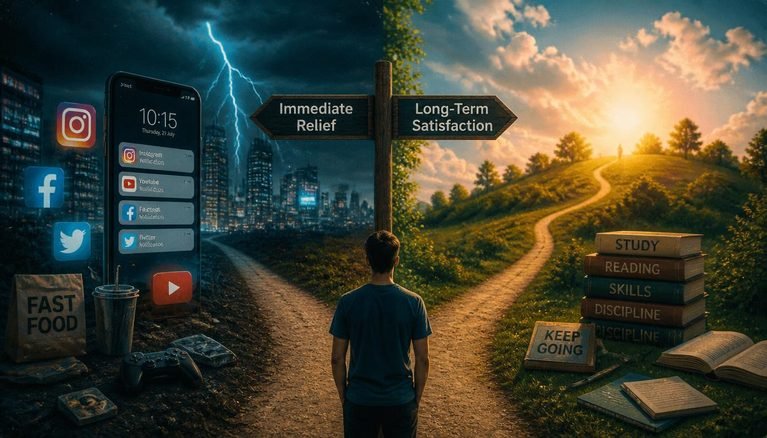
People have a tendency which behavioural economists refer to as Present Bias. For millions of years, our ancestors existed in situations in which immediate survival was the only important consideration. Whenever they came across food, they ate it, and when they saw a predator, they ran. There was no idea of saving for retirement, going on to get a master’s degree, or building a website.
As a result, our brains have developed a strong preference for immediate rewards rather than for long-term benefits.
Whenever you decide to set yourself the aim of writing a book, starting a business, or losing weight, the reward will not be available for months or years. Your modern, rational brain understands that this is a sound idea. But your primitive brain has no concern for the future and only wants to feel happy at the moment.
Distractions Are Designed to Beat Delayed Rewards
We must be honest about one thing: your phone is not a neutral object.
Social media, short-form videos, online games, and endless streams of entertainment are no different. Many of today’s distractions provide immediate stimulation with almost no effort.
You might be offered a reward for completing an important task in six months, while your phone can give you interesting information in just three seconds.
That is an unjust competition.
When you’re already feeling tired, stressed, or emotionally uncomfortable, the immediate reward then appears even more appealing. This is in accordance with the temporal motivation theories of procrastination, which stress the significance of delay, the value of the reward, and impulsiveness in explaining why people select one course of action rather than another.
So in some cases the question is not ‘Why can’t I concentrate?’
The question should be: “Why should my brain be expected to choose a delayed reward when it has unlimited access to immediate rewards?”
The Biggest Lie: Procrastination is Not Laziness
For many years society has described procrastination as a fault of character. We have been made to think that it is a sign of laziness, a lack of discipline, or of poor time management.
Science says otherwise.
As Dr. Fuschia Sirois and Dr. Tim Pychyl—two of the world’s foremost experts on the subject—point out, procrastination is an issue relating to emotional regulation and not one of time management.
The work itself isn’t what you’re avoiding when you put it off; it’s the negative emotions connected to that work. You aren’t lazy; you’re merely looking for some short-term improvement in your mood, even though it hurts your long-term dreams.
Internal Triggers: The Urge to Escape
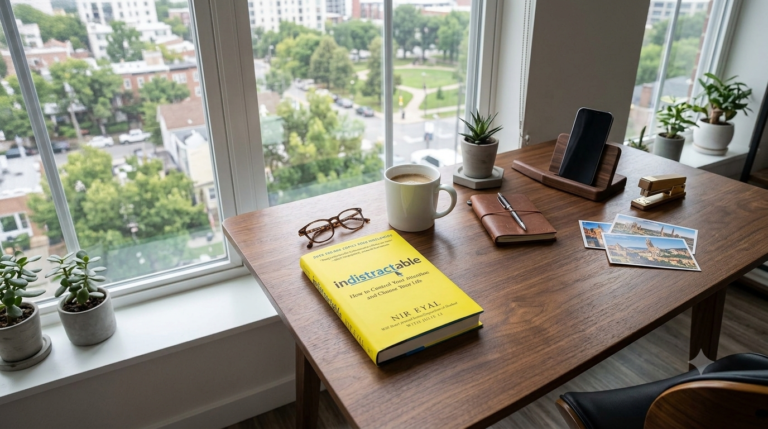
The irony is that even though I had just completed writing a book summary of Nir Eyal’s Indistractable for this website, knowing the science and the rules, I still ended up falling into the trap that Eyal refers to as an Internal Trigger.
An internal trigger is a negative emotion—such as boredom, loneliness, frustration, or self-doubt—which leads you to look for an escape. When I sat down to write on the subject of overthinking, I suddenly experienced a surge of anxiety and resistance. That unpleasant sensation was the internal trigger.
I didn’t take my phone since traffic videos are extremely interesting; I did so because looking at YouTube for a short while eased the anxiety caused by staring at a blank page.
Procrastination is the best way of coping with internal discomfort, and this discomfort is generally due to three particular psychological obstacles:
1. We do not think that we are capable of achieving it (low self-efficacy)
At times, procrastination masks a lack of confidence; when you look at the task, you think:
I have no idea how to carry out this task.
I may well end up getting this wrong.
I am far less good at this than other people are.
That’s why you don’t begin: by not starting, you avoid finding out whether you are actually capable of doing it; research has found that self-efficacy, the belief that one can successfully carry out a task, is a major factor linked to procrastination.
It sets up an unpleasant cycle in which low confidence leads to avoidance, which results in no progress, which in turn causes more guilt and then lowers confidence even further, leading to even more avoidance. The longer you delay it, the more intimidating the task becomes. In the end, the task stops being just a task and becomes proof of something about your worth. That is when procrastination starts to become emotionally costly.
2. The fear of failure causes delaying to seem ‘safer’.
Failing is unpleasant, but there’s a certain psychological advantage in failing since you ‘didn’t really try’.
Suppose two people submit poor work. One of them works for three weeks and then submits it, while the other starts the night before and submits it as well. If the second person is criticised, they can say to themselves, “Well, it’s clear that it wasn’t my best work; I just didn’t have enough time.”
The explanation helps to preserve their self-image since they need never face the more alarming possibility that “I put real effort into it and it wasn’t good enough”. For certain people, putting off the task offers a kind of psychological protection against having to be evaluated.
3. The task is simply too vague
“Work on my business.”
“Get healthier.”
“Write the book.”
They are not tasks; rather, they are vast and general aims, and the brain has no idea how to deal with them. If you compare “Work on my website” with “Open WordPress and write the introduction to one article for 20 minutes,” you will see this.
The second instruction provides your brain with a destination, while the first one gives it a mountain. If the tasks are unclear, difficult, or ill-structured, it becomes harder to get started. The task itself may have just been badly designed.
The 4 Types of Procrastinators (Which One Are You?)
1. The Perfectionist
Perfectionists do not delay because they do not care; on the contrary, they delay because they care too much. The fear of failure or criticism that we have already talked about is the reason that sets off their internal response. They will not carry out a task if they cannot do it perfectly, and by putting off action they create for themselves an excuse: “I didn’t produce my best work since I ran out of time.”
2. The Dreamer
People enjoy the planning stage. They purchase the domains, design the logos, and imagine the success. However, when it comes to the tough, dull day-to-day execution, they freeze. The reason inside them is the blunt truth that actual work is difficult and boring, a fact which destroys the fantasy of having an easy time of it.
3. The Crisis-Maker
The Crisis-Maker will boldly say to you, “I work better when under pressure.” This is a lie they tell themselves to justify their avoidance. They depend on the intense adrenaline and panic caused by a last-minute deadline to get themselves to act, since they do not have the internal motivation to begin unless there is an imminent threat.
4. The productive procrastinator (the over-doer)
This is the most dangerous form since it does not appear to be procrastination; if presented with a daunting and important task, they will suddenly go ahead and reorganise their whole digital file system, reply to 50 low-priority emails, or thoroughly clean the house. They engage in busywork in order to dull the anxiety associated with the real work that needs to be done.
The Toxic “Procrastination-Shame” Loop
There is a temporary feeling of relief when you put off the task, but soon afterwards guilt comes over you. You criticise yourself, telling yourself that you are lazy, stupid, or undisciplined, and you promise yourself that you will never do it again.
What effect does that shame have? It causes additional negative emotions.
When you criticise yourself, you cause your nervous system to release cortisol, the stress hormone. And the next time you attempt the task again tomorrow, your brain will see it as an even greater emotional threat than it did before. You are actually pouring gasoline on the fire.
How to Break the Cycle
It is impossible to plan enough to cope with an emotional regulation issue; no matter how attractive the new app is or how neatly the calendar is coloured, it won’t help you when your nervous system is in a state of full-blown avoidance.
You need to work with the psychology of your brain rather than fight it. Although I will be looking at this in detail in my next post with a step-by-step approach, here are three basic changes you must make if you are to stop the situation from worsening right away:
Reduce the threat: If your brain sees a large project as a threat, then reduce the stakes by committing to working on it for just two minutes. This will turn off the brain’s alarm system and create immediate momentum.
Research shows that when you forgive yourself for having been lazy in the past, your chances of putting things off in the future are greatly reduced and the toxic shame is eliminated.
Work out the internal trigger: before you access social media, stop and ask yourself, “What emotion am I really trying to escape at the moment?” By naming the emotion, you remove its hidden influence.
Half the problem is understanding the reason why you delay; the following stage involves actively reprogramming your habits so that you cease fighting yourself and begin to build the kind of life you want.
Are you ready to finally overcome this? Check out my full, step-by-step guide on “How to Stop Procrastinating and Take Your Life Back”.
About the Author
Manash Datta is the founder and author of The Inner Growth Lab, a website on which he examines subjects such as psychology, self-improvement, relationships, habits, and books; his writings are intended to present the ideas from psychology and personal development in a practical, relatable, and useful way for everyday life.
Sources & Further Reading
Steel, P. (2007).The Nature of Procrastination: A Meta-Analytic and Theoretical Review of Quintessential Self-Regulatory Failure. Psychological Bulletin. This major meta-analysis examined 691 correlations and remains an important foundation for modern procrastination research.
Sirois, F. M., & Pychyl, T. A. (2013).Procrastination and the Priority of Short-Term Mood Regulation: Consequences for Future Self. Social and Personality Psychology Compass. The paper develops the influential view of procrastination as short-term mood repair.
American Psychological Association.Why we procrastinate and what to do about it, with Fuschia Sirois, PhD. An accessible discussion of the psychological research on procrastination and emotion regulation.
Van Eerde, W., & Klingsieck, K. B. (2018).Overcoming procrastination? A meta-analysis of intervention studies. Educational Research Review.
American Psychological Association (APA): Why we procrastinate and what to do about it, featuring Dr. Fuschia Sirois (Durham University).




One Comment