
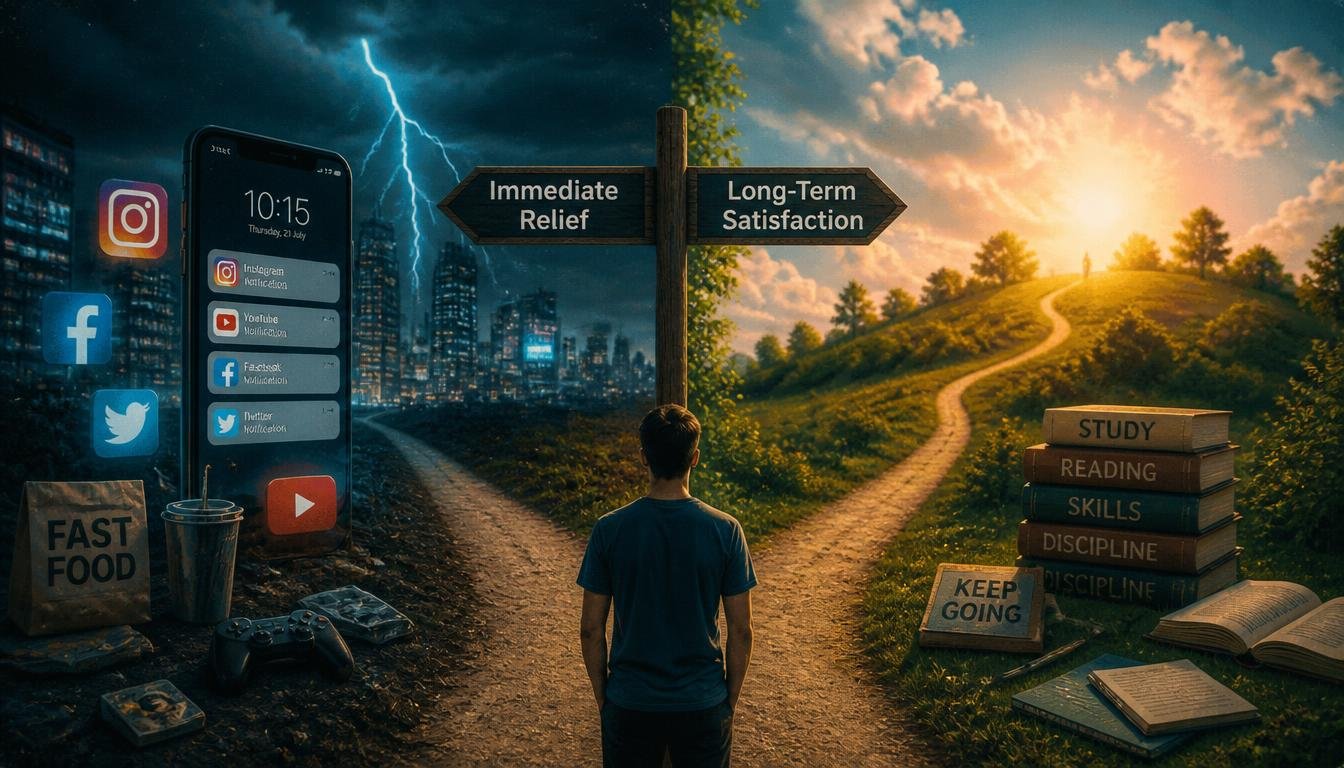
Why Your Brain Chooses Distraction Over Focus?
“Why do I keep doing things I don’t even enjoy, while avoiding the work I know would make me happier?”
If you’ve ever caught yourself asking that, you’re in good company.
Most of us assume that distraction means we’re lazy, unmotivated, or simply don’t care enough. But psychology suggests something much more interesting.
The problem usually isn’t a lack of motivation.
It’s that your brain is trying to solve the wrong problem.
We Think We’re Chasing Pleasure
Picture this.
You sit down to study for an exam, finish an important project, or finally work on that skill you’ve been meaning to learn.
A few minutes pass.
Almost without thinking, you reach for your phone.
You scroll Instagram.
Watch a YouTube video.
Check the news.
Before long, twenty minutes have disappeared.
You don’t feel refreshed—you feel guilty.
An hour later, that guilt has turned into anxiety, and by the end of the day you’re less satisfied than when you started.
So why would your brain choose something that leaves you feeling worse?
Because it wasn’t choosing pleasure.
It was choosing relief.
The Hidden Cost of Getting Started
Deep, meaningful work has an entry fee.
Before you settle into a state of focus, you usually have to push through:
- uncertainty
- mental effort
- fear of failing
- perfectionism
- delayed rewards
Those first few minutes can feel uncomfortable, and your brain notices.
Distraction offers something much easier.
No pressure.
No judgment.
No chance of getting it wrong.
Just instant relief.
The catch is that the relief doesn’t last.
If you’d stayed with the task for another ten or fifteen minutes, there’s a good chance the work would have become more engaging. But distraction keeps you from ever reaching that point.
Why the Things That Matter Most Are Hardest to Start
People often think we procrastinate because we don’t care.
In reality, we often procrastinate because we care too much.
The projects closest to our hearts carry emotional weight.
When something feels important, it quietly becomes tied to our identity.
Instead of thinking, “I’m going to study for two hours,” your mind subtly shifts the story to, “I’m about to find out whether I’m actually capable.”
That’s a lot of pressure to put on a simple study session.
When Distraction Is Really Emotional Escape
Sometimes we’re not avoiding the work itself.
We’re avoiding what the work represents.
Starting can bring uncomfortable questions to the surface:
“What if I fail?”
“What if I’m not as capable as I thought?”
“What if I’ve already fallen too far behind?”
Your brain naturally wants to avoid that uncertainty.
Scrolling through your phone doesn’t answer those questions.
It just postpones them.
And postponed anxiety has a way of coming back even stronger.
Why Distraction Leaves Us Feeling Worse
This is the cycle many people know all too well:
The work feels overwhelming.
So we distract ourselves.
For a moment, we feel better.
Then we fall behind.
The anxiety grows.
Now the task feels even bigger than before.
Eventually, the brain stops associating the task with curiosity or growth.
Instead, it links it with guilt.
Breaking that cycle isn’t about suddenly becoming more disciplined.
It’s about changing the emotional relationship you have with the work.
Focus Isn’t Never Getting Distracted
There’s a common belief that highly successful people stay focused because they never get distracted.
That’s simply not true.
Everyone’s mind wanders.
The difference is what happens next.
Focused people notice.
Then they come back.
Again.
And again.
Every return is another repetition.
Every repetition strengthens your ability to pay attention.
Focus isn’t a switch you flip.
It’s a muscle you train.
A Better Question to Ask
Instead of asking,
“Will I succeed?”
try asking,
“Can I just get through the next page?”
The first question creates anxiety because it asks your brain to predict the future.
The second creates momentum because it only asks for one small action.
The future isn’t built through one heroic effort.
It’s built by returning to the work, over and over again.

Final Thoughts
Distraction isn’t proof that you’re weak or incapable.
More often, it’s your brain trying to protect you from uncertainty, discomfort, or emotional pain.
The goal isn’t to eliminate distraction forever.
The goal is to notice it, understand it, and gently bring your attention back to what matters.
Every time you return, you’re doing more than making progress on your work.
You’re strengthening one of the most valuable skills you can develop:
The ability to come back.
Key Takeaways
- Your brain often chooses immediate relief over long-term satisfaction.
- The work that matters most is often the hardest to begin because it feels emotionally significant.
- Distraction is usually about avoiding discomfort, not chasing pleasure.
- Focus isn’t about staying perfectly concentrated—it’s about repeatedly returning when your attention drifts.
- Small, consistent returns to the task shape both your habits and your identity over time.




very helpful article
Very thoughtful and well written article. It answred questions i couldn’t even ask properly.